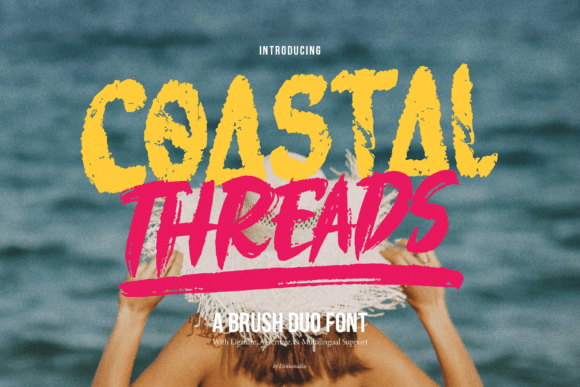
Coastal Threads is a script handwritten font that brings a touch of elegance and personality to digital design. I first encountered it while working on a boutique online store project, where the goal was to create a clean, modern, and inviting user experience. The client wanted a brand identity that felt approachable yet professional, and Coastal Threads fit perfectly in that space.
As a web designer, I often test fonts in real layout scenarios—like hero sections or mobile menus—to see how they perform. Coastal Threads stood out for its soft, flowing lines and natural feel. It’s not overly ornate, which makes it versatile for both digital and print use. The font has a warm, handcrafted aesthetic that adds character without overwhelming the design.
One of the first places I used Coastal Threads was in the hero section of the online store. The headline needed to grab attention but also feel part of a cohesive visual language. The font’s curves and subtle variations gave it a personal, artisanal vibe that aligned with the brand’s values. It worked well with a minimalist background, allowing the text to breathe and stand out.
In the context of a product landing page, Coastal Threads can be used for section headings, call-to-action buttons, or short promotional phrases. Its readability is strong at larger sizes, making it ideal for titles and logos. However, I found that it’s best suited for display purposes rather than long blocks of body text. For that, pairing it with a simple sans serif font like Open Sans or Lato made the design more balanced and legible.
When testing Coastal Threads on mobile screens, I noticed that the font maintains clarity even at smaller sizes. The strokes are consistent enough to prevent distortion, and the spacing between letters allows for easy reading. This is especially important for CTA buttons or navigation menus where users need to scan quickly. On dark backgrounds, the font still holds up, though I recommend adjusting the contrast slightly for optimal visibility.
For a coaching website, Coastal Threads could serve as a logo typeface or a heading font for key sections. It adds a human touch that resonates with audiences looking for authenticity and connection. In blog headers or course pages, it helps create a visual hierarchy that guides the reader through the content. The font’s style works well with image overlays, as it doesn’t clash with complex backgrounds and remains readable against textures or gradients.
I also considered how Coastal Threads might perform in social media graphics or email campaigns. Its handwritten quality gives a personal, friendly tone that’s great for engagement. When paired with a more structured font for body copy, it creates a dynamic and visually interesting layout. This kind of font pairing is common in editorial design and can elevate the overall look of a digital asset.
Another consideration is the availability of different weights and styles. Coastal Threads likely includes multiple variants, such as regular, bold, and alternate characters. These options allow for more flexibility in design, enabling the font to adapt to various roles within a layout. For example, a bold version could be used for headlines, while a lighter weight might work for subheadings or captions.
Multilingual support is an important factor when choosing a font for global audiences. If Coastal Threads supports non-Latin scripts, it opens up more possibilities for international branding. But if it’s limited to Latin characters, it’s still a strong choice for English-speaking markets.
From a technical standpoint, ensuring that the font is available as a webfont is crucial. Web designers need to check for proper file formats, such as WOFF and WOFF2, and confirm that the licensing allows for commercial use. This is especially important when working on client projects or e-commerce sites where the font will be publicly accessible.
In a digital brand kit, Coastal Threads can be used consistently across all touchpoints—website headers, social media profiles, email templates, and promotional materials. This consistency helps reinforce brand recognition and creates a unified visual identity.
For a portfolio homepage, the font can be used to highlight key projects or services. Its flowing style adds a creative flair that complements artistic or design-focused work. When placed over an image banner, it enhances the storytelling aspect of the site without distracting from the visuals.
In a course sales page, Coastal Threads can be used for title cards or section dividers. Its personality helps break up dense content and keeps the design engaging. It’s also a good option for promotional banners or countdown timers, where a unique, eye-catching font can drive action.
Overall, Coastal Threads is a premium font that offers both style and functionality. It’s a great choice for web designers looking to add a personal, handmade touch to their layouts. Whether used for a boutique store, a coaching site, or a creative portfolio, it brings a sense of warmth and authenticity that resonates with modern audiences.